
How to Search Criminal Dockets
Start with the court level, not just a name. The Archer County District Clerk takes felony, civil, and family questions, and the county's contact directory routes those calls accordingly. County misdemeanors belong to the County Clerk. Traffic and other Class C cases may sit in a justice or municipal court instead. The District Clerk's site links "Court Records Search" to the Texas UCMS public portal, where Smart Search pulls court records and Search Hearings lists settings by date range.
A cause number is the strongest key. Without one, gather the defendant's full name, a rough filing or hearing date, the offense level, and the court on the charging paper. Then take the path that fits:
- Identify the court from the citation, bond paper, notice, or charging document.
- Open the county-linked Odyssey portal and use Smart Search for the case.
- Use Search Hearings when the goal is a setting rather than the whole case.
- Compare the charge, court, date, and cause number before relying on a match.
- Call or visit the responsible clerk when the result is missing or a copy is needed.
Archer Criminal Docket Cause Codes
Archer County's official jury docket archive reveals a handy numbering pattern. Sample criminal causes there follow CR-YYYY-NNNNN. The "CR" marks the criminal series. The middle segment is a year, and the trailing digits separate one cause from the next. Copy every letter, hyphen, and zero. One slipped character can pull up no match at all or an entirely different file.
Remember, the archive is historical rather than a live register. Its real lesson is precision. A name can be spelled several ways, but a cause number stays tied to the court's file. That is what links a portal search, a clerk call, and a document request.
What an Archer Criminal Docket Shows
A docket is a dated list of events. It is not a copy of every paper in the file. The historical jury sheet is even narrower. It carries trial-call information in five columns: cause number, defendant, charge, attorney, and bondsman. A full electronic docket can go much further. It may include filings, motions, settings, pleas, bond actions, disposition, costs, and appeal activity. Exact labels depend on the court and the system.
| Cause number | The court identifier, with sample pattern CR-YYYY-NNNNN. |
|---|---|
| Charge | The filed offense text or shorthand, which may not state the final outcome. |
| Settings | Arraignment, pretrial, status, plea, jury, or trial dates, including resets. |
| Participants | Attorney and bondsman fields when the specific docket displays them. |
| Disposition | The result or closing status, best confirmed against the signed judgment. |
Dates deserve a careful read. A filing date marks when the clerk received an item. That may not match the event date. Likewise, "set" means scheduled, while "heard" means it actually happened. Treat the entry and the underlying document as two separate layers.
Archer Criminal Jury Docket
The county’s jury docket archive currently displays 2018 dates. It is valuable as a format sample, but it should not be treated as today’s criminal calendar. The archive demonstrates how a jury-call sheet can combine case rows with readiness and appearance instructions.
The official county source shows the archived docket page.
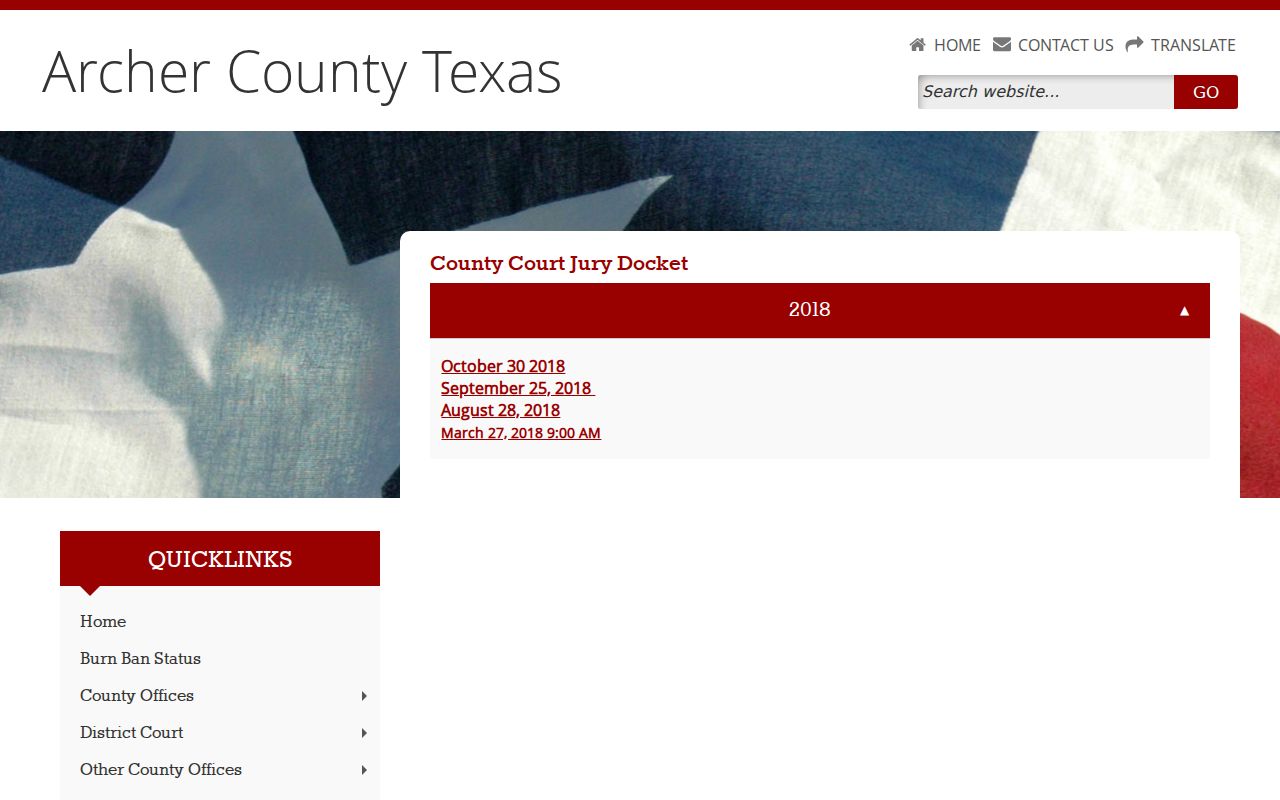
That page proves a key limit. An archived date and a current setting are two different things. Confirm anything upcoming through Search Hearings or the responsible clerk.
Stages on a Criminal Docket
A felony docket in Archer County may open with a charging event and then run through arraignment, pretrial settings, motions, plea or trial, and disposition. County misdemeanors follow the constitutional County Court's process. Class C matters stay with a justice or municipal court. Not every case hits every step, though. A reset can add several setting entries without changing the charge or the result.
Docket flow: Charge Filed › Arraignment › Pretrial Settings › Plea or Trial › Disposition › Sentence or Appeal
The signed judgment or sentence is the operative document. A docket line can point to it, but it is no certified substitute. When requesting a formal copy, give the cause number, the document's name, and whether you need certification.
Archer Criminal Readiness Rules
Archer's posted jury instructions show why calendar text matters. One sample required written readiness announcements by a stated deadline. A party claiming "not ready" had to file a detailed motion for continuance. It had to be properly filed or e-filed. Skipping the announcement counted as ready. Only the County Judge could excuse counsel or a defendant.
A second sheet told parties to file pretrial motions at least ten days before trial. Bench-warrant matters were to be handled seven days before trial. Those deadlines come from a posted sample, not a promise about every current case. Always check the present order, the docket entry, and the local rule. The Texas local-rules search works as a cross-check. Still, the court or coordinator remains the authority on the setting at issue.
Which Court Holds Criminal Dockets
Felony matters in Archer County go through the 97th Judicial District Court, and the District Clerk keeps that criminal file. The court also serves Clay and Montague Counties, so pick the right county when confirming a portal result. The Archer County constitutional County Court handles Class A and B misdemeanors, filed through the County Clerk. Justice Courts in Precincts 1 through 4 and the municipal courts handle fine-only offenses within their jurisdiction.
The split is simple in practice. Call the District Clerk at 940-574-4615 for felony records and the County Clerk at 940-574-4302 for county misdemeanors. The county contact directory lists 940-574-4514 for traffic tickets. For a municipal citation, check with the city court printed on it. No single docket search covers all of those offices at once.
Archer Criminal Portal Limits
The Texas UCMS Public Access Portal requires JavaScript and cookies. Its landing page separates Smart Search from Search Hearings. Search the case when the goal is its event history. Search hearings when the question is when or where an appearance is set.
The official Tyler portal source shows those two public entry points.
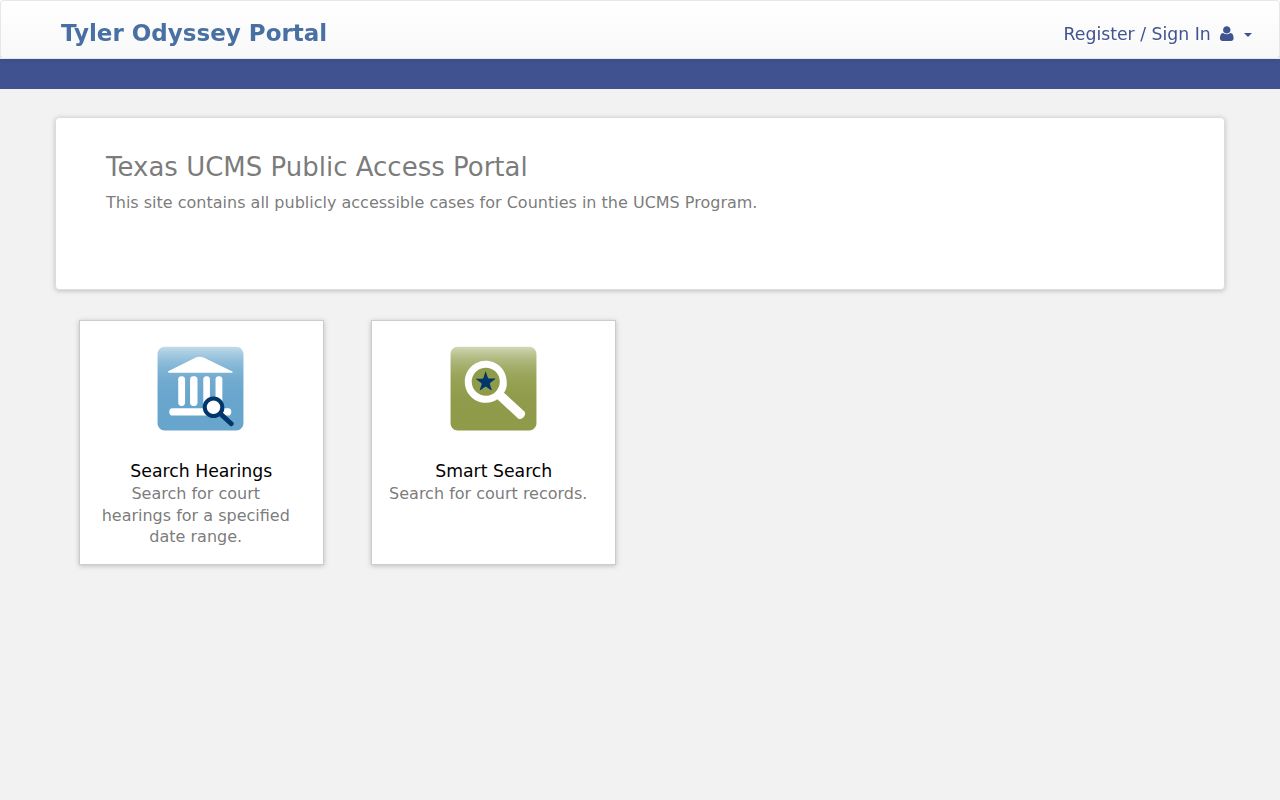
Online results are a convenience, not a promise. The portal may not show every Archer County criminal filing, so a missing case proves little. Scripts can fail. Older cases may sit outside the system. When a search comes up empty, call the clerk or use the counter or mail.
Public Access and Sealed Criminal Dockets
Court records in Texas answer to court rules first. Texas Government Code Section 552.0035 explains the split. A normal Public Information Act request does not automatically control judiciary records. For the access process itself, Rule 12 of the Rules of Judicial Administration does the work. A good request names the record, the court, the cause number, and a date range. Tell the custodian whether you want to inspect it or get a copy.
Key access rules:
Texas Government Code § 552.0035 places judiciary information under court rules or other law.
Texas Rule of Judicial Administration 12 governs requests for judicial records.
Texas Rule 21c requires protection of specified sensitive data in filings.
Not every missing docket is missing for the same reason. Sealed, expunged, nondisclosed, juvenile, redacted, and simply undigitized records all sit outside public view differently. An empty online result proves none of these on its own. The clerk can say whether an item is restricted. The clerk can also say whether it is archived, excluded from the web, or open to a copy request.
re:SearchTX Criminal Coverage Gap
re:SearchTX opens statewide Cases, Filings, Text, and Hearings searches to anyone with eFileTexas credentials or registration. One gap matters here. The cited Texas Judicial Council report says criminal case records were left out of that rollout, so treat it as a cross-check rather than a full Archer County criminal search.
Keep the cause number and entry date whenever sources clash. Then ask the Archer clerk by exact name for a docket sheet, indictment or information, bond, motion, order, judgment, sentence, or clerk's record. The District Clerk's 2024 fee sheet lists a $5 search charge plus other fees, though the clerk should quote the current cost and delivery method.